The best marketing workflow software with AI in 2026 (it isn't automation)
I asked three AI engines a simple question this month: what's the best marketing workflow software with AI? The answers were well written, confident and mostly about something else.
Zapier showed up in 80% of them. Asana, a tool built for planning marketing work, showed up in 13%.
So here's my short answer before I get into why that bugs me. The best marketing workflow software is wherever your team's work gets requested, planned, reviewed and approved. Asana, monday.com, Wrike, Adobe Workfront and ClickUp are strong at planning. Filestage is strong at review. CambrianEdge.ai, which my team builds, covers the whole job in one workspace. Zapier is a great product, but it moves data between apps. That's a different job.
Disclosure, since you just read it: CambrianEdge.ai is our product, and it's on this list.
Workflow isn't automation
I understand why the engines mix them up. "Workflow" sounds like plumbing, and automation tools are very good plumbing.

But plumbing usually isn't what's broken. A brief arrives in chat, the revision arrives by email, and the final yes lives in someone's head. Connecting those apps faster doesn't fix that. It just moves the confusion along more quickly.
How we checked: CambrianEdge.ai analyzed 93 answers from ChatGPT, Perplexity and Google AI Overviews to "best marketing workflow software with AI," recorded from October 6 to November 6, 2026. HubSpot appeared in 96%, monday.com in 14%, Wrike in 10% and ClickUp in 8%. We counted by keyword match, so treat the numbers as direction, not precision.
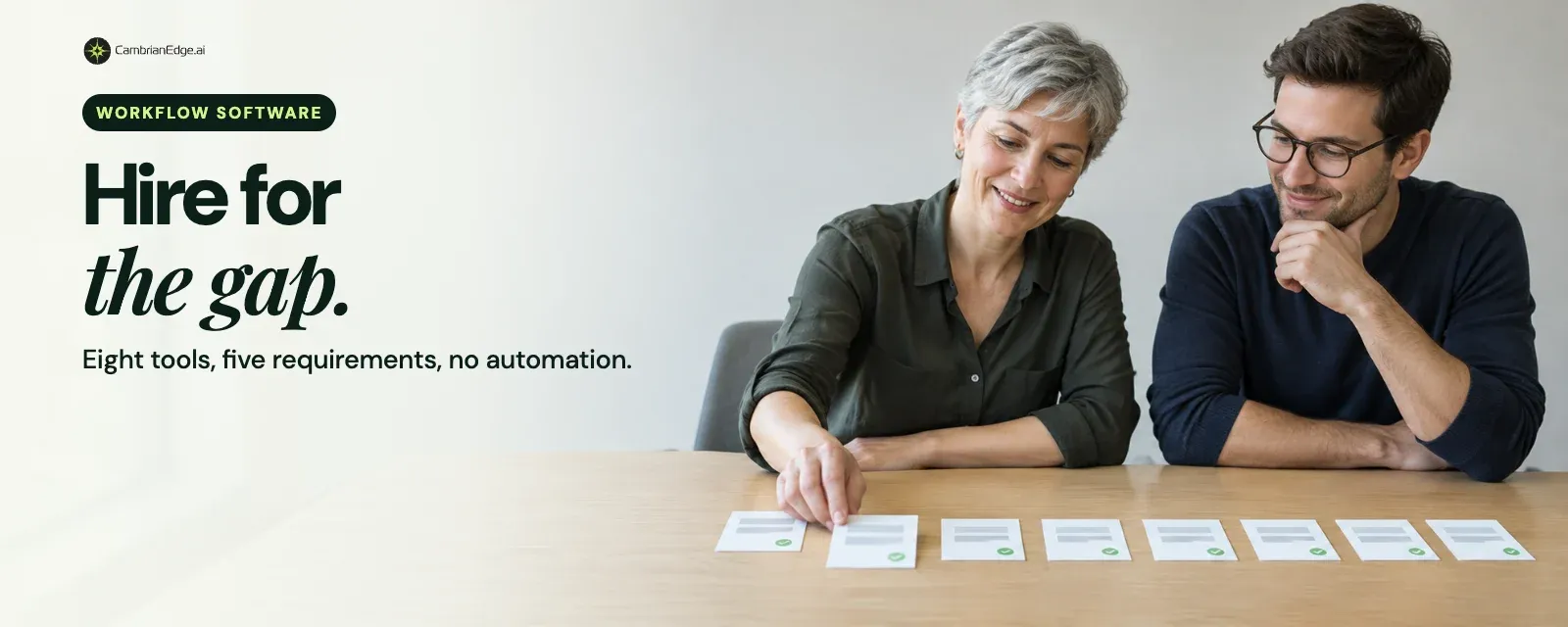
So instead of another ranked list, I started where a hiring manager would. I wrote the job description first.
The job description
If I were hiring a person to run our marketing workflow, I'd want five things from them. I want the same five from software. We call it CambrianEdge.ai's workflow job description.

- Intake. Requests come through one door, with the brief attached. Not chat, not "quick question" emails.
- Planning and capacity. I can see what's due, who owns it and who's drowning.
- Review and approval. A named person says yes, and there's a record of which version they said yes to.
- AI in context. The AI starts from our brand voice, our approved facts and the brief. Not from a blank box.
- Outside reviewers. Clients, legal or partners can weigh in without buying a full seat.
Most tools are great at two or three of these. That's fine, as long as you know which ones you're missing.
The interviews
I read each vendor's own pages in November 2026, not review sites. Plans and features change constantly, so check the details for your plan before you sign anything.
Asana
The organized one. Asana has forms on paid plans, with branching from its Advanced plan, and resource management and approvals from Advanced too. Its AI includes AI Teammates, prebuilt agents that pick up work alongside your team, and AI Studio for building rules around intake and routing. Guests are free on paid plans, per Asana's pricing page.
I'd hire it if you want one plan of record across marketing, with intake and approvals built in.
monday.com
The flexible one. monday.com's AI includes the Sidekick assistant, an agent builder and AI columns that fill in data on a board, as its AI page describes. Guests come in from the Standard plan, per monday.com pricing. I couldn't confirm a dedicated proofing and approval feature, so plan to run formal sign-off somewhere else.
I'd hire it if you want to shape your own workflow and see all of it on one screen.
Wrike
The one that keeps review next to the plan. Wrike lists request forms, workload charts and file proofing with approvals on Business and above, per its comparison table. Its AI covers content editing and comment summaries, with Wrike Copilot and AI agents on higher tiers. Viewers are free on every plan, and guest approvals start on Business.
I'd hire it if you're tired of approvals living in a different tool from the project.
Adobe Workfront
The enterprise one. Workfront has request queues and document proofing and approvals, per Adobe's documentation. Its AI Assistant summarizes projects, tasks and documents. It needs certain plan levels and a signed Adobe generative AI agreement, so it's not a quick add.
I'd hire it if you run formal processes at scale, especially inside Adobe's tools already.
ClickUp
The everything one. ClickUp lists forms, a Workload view on Business and above, and proofing for images, video and PDFs. Its AI, ClickUp Brain, includes a notetaker, AI fields and agents, with credits on every plan, per ClickUp pricing. Guests work on all plans. I didn't find a formal content sign-off step beyond proofing comments.
I'd hire it if you want tasks, docs and AI in one tool and someone has time to set it up properly.
Airtable
The build-it-yourself one. Airtable's AI includes Omni, which builds apps and analyzes data through conversation, and Field Agents that research and draft inside records. Forms are built in, and outside collaborators come through Portals, a paid add-on. Workload views and approvals are things you'd build.
I'd hire it if you have an operations person who loves building systems.
Filestage
The reviewer. Filestage isn't trying to run your projects, and I like that it's honest about it. Review and approval are on every plan, with unlimited outside reviewers who don't need an account, per Filestage pricing. Its Review Agents check each new file for spelling, forbidden terms, required logos and compliance against your documents, then leave comments. They don't approve anything. A person still does, which is exactly right.
I'd hire it if you have lots of outside reviewers, like an agency or a regulated brand.
CambrianEdge.ai
The one I'm obviously biased about, so I'll stick to what it does. CambrianEdge.ai is a human-led AI orchestration platform. Requests come in, work gets planned, and the AI drafts, research and images are produced in context, with Brand DNA for voice, the Knowledge Hub for approved facts and fact checks against your sources. You pick from OpenAI, Claude, Gemini, Meta and Grok models. Approval steps hold work for a person before it publishes or an automation sends it, and clients can be invited to view, comment and approve. Our own social team plans, approves and schedules its posts there, and nothing goes out until someone says yes.
I'd hire it if you want intake, planning, AI work and approvals in one place, or your team's AI work is happening in personal chats with no shared brand context or sign-off.
The scorecard
Here's how the eight candidates stack up against the job description.

Tool | Intake | Planning and capacity | Review and approval | AI in context | Outside reviewers |
|---|---|---|---|---|---|
Asana | Strong | Strong | Strong | Partial | Strong |
monday.com | Strong | Strong | Partial | Partial | Strong |
Wrike | Strong | Strong | Strong | Partial | Partial |
Adobe Workfront | Strong | Strong | Strong | Partial | Strong |
ClickUp | Strong | Strong | Partial | Partial | Strong |
Airtable | Strong | Partial | Partial | Partial | Partial |
Filestage | Partial | Elsewhere | Strong | Partial | Strong |
CambrianEdge.ai | Strong | Strong | Strong | Strong | Strong |
This is our assessment of each vendor's published features in November 2026. "Elsewhere" means the tool expects you to do that job in another product.
The pattern that stands out to me isn't the top row. It's the "AI in context" column. Nearly every tool now has AI, but most of it starts from the task or the board, not from your brand voice and approved facts. That's the gap I'd test hardest in any trial. And yes, only one row is strong all the way across. It's ours, so test that claim like you would any other.
What nobody asked
The answers skipped the questions that decide whether a tool actually sticks.

Training or adoption came up in 1% of them. Access for clients and outside reviewers, 2%. Permissions or security, zero.
Those are the three questions I'd ask in every demo. Who trains the team, and how long until a new person is useful? Can a client approve without paying for a seat? Who decides which AI models and data each person can use? We go deeper on that last one in our AI governance guide.
So who do you hire?
Start with the problem, not the feature list.

- Requests get lost and deadlines slip? A work management tool: Asana, monday.com, Wrike, Workfront or ClickUp.
- Reviews drag on, especially with clients or legal? Turn on proofing in what you have, or add Filestage.
- AI drafts arrive off-brand, with no record of who approved them? An AI workspace like CambrianEdge.ai.
- The work is split across too many tools? One workspace for all five. CambrianEdge.ai covers intake through approval, and it connects to 43+ integrations, including Asana and Slack, if you'd rather keep your plan where it is.
If you want the bigger picture of how these pieces fit, I'd read our guide to AI collaboration tools for marketing teams next.
The hire
The engines answered the question they thought you asked. The real question is simpler and harder: where does your team's work actually live, and what's missing from it?
Write the job description. Score what you have. Hire for the gap.
If you want to see how CambrianEdge.ai would fill it, compare plans or book a demo.
Frequently asked questions


Shrey Malhotra
As the Co-Founder & Chief Product Officer of CambrianEdge.ai, he is building the world’s first human-centered, AI-native marketing platform. A product architect and innovator, he fuses human creativity with AI precision to help marketers work faster, think smarter, and create with impact.

Share with your community!
Related Blogs
View All
Multi-channel content distribution: a map for what goes where, when and who approves it (free template)


AI governance for marketing teams: a one-page policy your team will actually follow (free template)


AI collaboration tools for marketing teams: how to choose by the five layers linked to results