How to build an AI content approval workflow (free template)
It is 4:52 p.m. on a Thursday. A post drafted by AI, promising customers a "guaranteed" result, is scheduled to go live at 5:00, and three people have looked at it without anyone approving it.
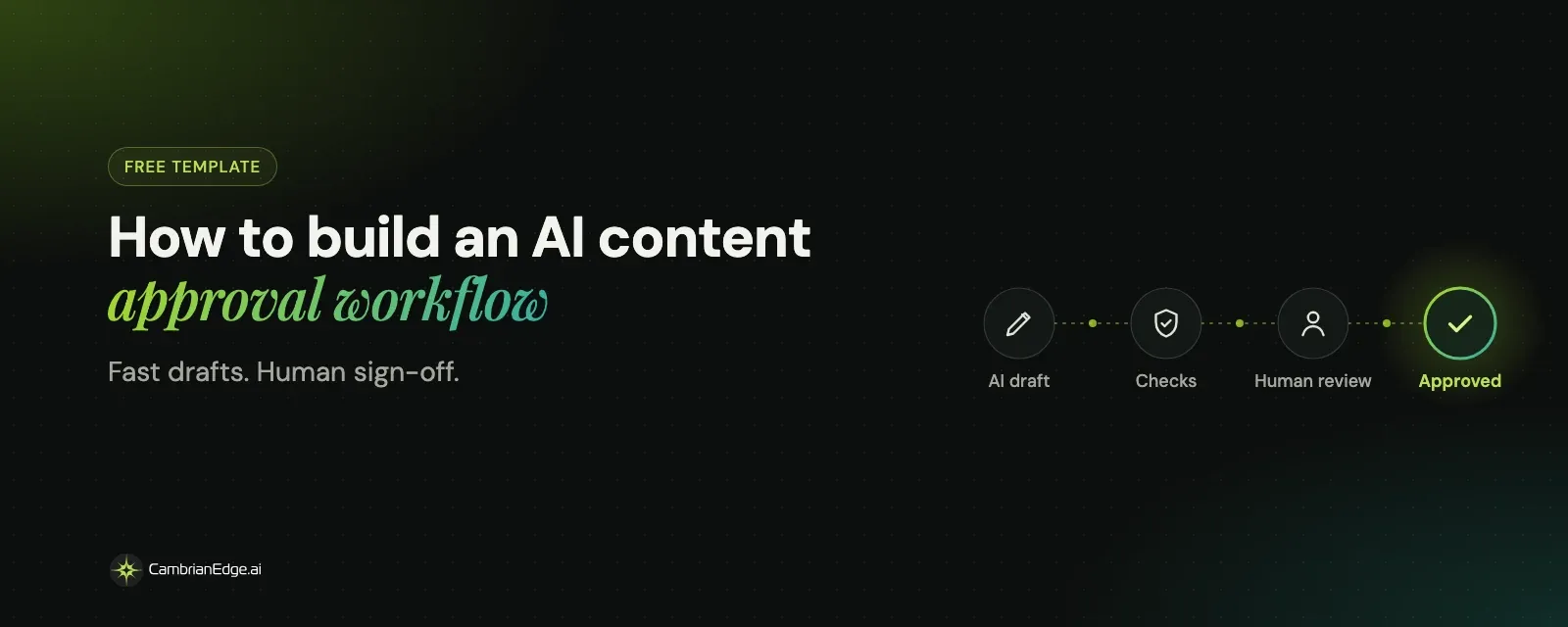
An AI content approval workflow exists to stop that moment. It is a set of required steps between an AI draft and publishing that defines who checks what, how much review each piece needs, and who signs off, with a record kept. AI can prepare and check the work. Only a named person approves it.
That Thursday scene is made up. The pattern behind it is not. Most marketing teams adopted AI writing tools long before they decided who was responsible for what those tools produced.
Why do AI drafts slip through review?
AI drafts slip through because review was designed for a world where drafting was slow. Now drafting takes seconds, and the review process has not changed to match.
In our AI at Work: The Collaboration Gap research with 136 professionals in 14 countries, 62% said their organization has no defined process for handing AI-generated work to a human reviewer. Without one, four things go wrong:
- Nobody owns the final yes. Three people glance at a draft and each assumes someone else approved it.
- Reviewers check the wrong version. An edit lands after sign-off, and the version that ships is not the one anyone approved.
- Every draft gets the same review. A routine post waits in the same queue as a regulated claim, so either everything is slow or nothing is checked properly.
- Reviewers re-check the basics every time. Brand voice, product facts and approved claims get debated from scratch on every draft.
The last one is the most expensive, and it is the one most guides miss. My colleague Harjiv Singh wrote about the result in The Approval Queue Is Becoming Marketing's New Bottleneck: the time AI saves in drafting disappears in review.
Approve the inputs, not just the outputs
The fastest approval workflows move most of the judgment to the start. You approve the inputs once, and reviewers only check what is new.
Inputs worth approving up front:
- Brand rules. Voice, tone, words you use and words you never use.
- Approved claims. The product facts, numbers and promises you are allowed to make, with their sources.
- Required disclosures. Wording legal has already signed off for offers, pricing or regulated topics.
- Model access. Which AI models your team is allowed to use, decided once at the organization level.
When the AI drafts from approved inputs, a reviewer no longer asks "is this on brand and true?" from a blank page. They ask a much smaller question: "is anything here new, and is it right?" That is where review time comes back.
This is how we designed approvals at CambrianEdge.ai. Brand DNA holds each brand's voice and guidelines, the Knowledge Hub holds the approved documents and facts the AI drafts from, and claims are checked against your sources before a person ever sees the draft.
The AI content approval workflow template
Use this template as a starting point. Adjust the owners to your team, but keep one rule: each stage has a single owner and a clear exit.
Stage | Owner | What happens | Done when |
|---|---|---|---|
1. Brief | Requester | Goal, audience, channel, risk tier and approved sources are set | The brief names a risk tier |
2. AI draft | Writer with AI | AI drafts from brand rules and approved facts | Draft cites the sources it used |
3. Automated checks | The system | Claims compared with the approved list, banned phrases, links and disclosures checked | Every flag is fixed or sent to a person |
4. Editor review | Content lead | Voice, accuracy, clarity and audience fit | Approved, or changes requested once with clear notes |
5. Specialist review | Compliance, legal, subject expert or client | Claims, disclosures and regulated language (tier 3 only) | Signed off in writing |
6. Final approval | Named approver | Approves the exact version that will ship | Approval recorded with name and time |
7. Publish or send | The system | Goes out only from the approved version | Live, matching the approved version |
8. Log and learn | Marketing ops | Record the decision and track rework | Reviewed weekly |
Two details make the difference. Any material edit after stage 6 sends the piece back to stage 6. And stage 7 should be locked, so nothing can publish without a recorded approval.
How much review does each piece of content need?
Match review depth to risk. Three tiers cover most marketing teams.
Tier | Typical content | Review needed |
|---|---|---|
Tier 1: low risk | Internal drafts, repurposed approved content, routine social posts from an approved calendar | One approver |
Tier 2: medium risk | Customer emails, newsletters, blog posts, landing pages | Editor review plus final approval |
Tier 3: high risk | Paid ads with offers, pricing, health, finance or legal claims, crisis communications, client deliverables | Specialist review plus final approval |
Set the tier in the brief, not at the end. A piece that starts as tier 1 and quietly acquires a pricing claim should move up a tier automatically.
The reviewer checklist
Give every reviewer the same short list. Vague instructions like "make sure it looks good" are how 4:52 p.m. happens.
- Every factual claim matches the approved claims list or has a cited source.
- Numbers, dates, names and prices are correct.
- The voice matches the brand rules for this audience.
- Required disclosures are present and worded exactly as approved.
- No promises the product or service cannot keep.
- Links work and point to the right pages.
- The call to action is correct for this channel.
- You are approving the final version, not an earlier one.
This is not only good practice. The FTC has made clear that marketing claims involving AI must be truthful and backed by evidence, and its Operation AI Comply sweep targeted companies that broke that rule.
What should an approval log record?
An approval log should record enough to answer "who approved this, and what exactly did they approve?" months later.
- The asset, its channel and its risk tier
- The sources and approved claims the draft used
- The AI model used for the draft
- Each reviewer, their decision and the time
- The version that was approved and the version that shipped
- Any changes requested and why
NIST's Generative AI Profile recommends verifying the sources and citations in generative AI output and keeping a full document history for auditing. A good approval log does both for marketing.
How do you keep approvals from becoming the bottleneck?
Keep approvals fast by giving each stage a time limit, running specialist reviews in parallel, and sending reminders where people already work.
Structure is what makes teams faster, not slower. In the same AI at Work survey, teams with defined hand-offs between AI and people reported significant outcomes 71% of the time, against 38% for teams without them.
- Time-box each stage. Same day for editor review, 24 hours for specialist review.
- Run specialist reviews in parallel. Legal and brand can review at the same time.
- Request changes once. One round of consolidated notes beats five scattered comments.
- Remind people where they work. Approval requests should reach reviewers in Teams, Slack or email, not wait in a tool they rarely open.
- Measure two numbers. Time from draft to approval, and the share of first drafts approved without major changes.
How we run it ourselves
We use this workflow on our own marketing every week.
Our in-house social media team runs its whole social flow on CambrianEdge.ai, from drafting to auto scheduling and publishing, with the approval step built into that flow. A post is scheduled only after someone approves it.
Our customer success team runs several automations that produce different newsletters. Each automation has an approval step inside it, so the newsletter is drafted automatically but goes out only after a person approves it.
The platform features behind this are the same ones our customers use on the approvals and governance page:
- Roles per workspace. Owner, Admin and Manager roles, so everyone has exactly the access their job needs.
- Approval points. Work stops before publishing and before an automation writes to another system.
- A full record. Version history, comments and run history show who did what, and when.
- Reminders where people work. Approval requests reach reviewers in Teams, Slack or email.
- One rule we never bend. An owner can override a step. AI never can.
Thursday, 4:30 p.m., replayed
Run the opening scene again with the workflow in place.
The post was briefed as tier 2 because it makes a customer promise. The AI drafted it from the approved claims list. At 4:05, the automated check flagged "guaranteed," because that word is not on the list. The editor swapped in the approved wording and approved the post at 4:30. It went live at 5:00, on time, saying only what the company can stand behind.
Nobody worked late. Nobody guessed who had said yes. That is the point of an AI content approval workflow: it lets AI make the team faster while people stay in charge of what goes out.
If you are still choosing the tools that feed this workflow, start with our guide to the best AI tools for marketing agencies, picked by job. If you want to see these approval points working on your own content, explore the plans or book a demo.
Frequently asked questions


Shrey Malhotra
As the Co-Founder & Chief Product Officer of CambrianEdge.ai, he is building the world’s first human-centered, AI-native marketing platform. A product architect and innovator, he fuses human creativity with AI precision to help marketers work faster, think smarter, and create with impact.