CMOs Don't Need Another AI Roadmap
Most CMOs have an AI roadmap. Most have two or three, stacked in different decks, built by different consultants, agreeing with each other in principle and going nowhere in practice.
That's not a knock on the roadmaps. It's a diagnosis of the wrong problem.
Gartner's 2026 CMO Spend Survey found that 70% of CMOs now name becoming an AI leader as a critical priority. The same survey found that 70% admit their internal marketing processes aren't mature enough to actually implement and scale AI. Budgets have barely moved — 7.8% of revenue, essentially flat on last year — while AI-ready organizations are already spending 21.3% of their marketing budget on AI and pulling ahead. The strategy isn't the bottleneck. The organization is.
The roadmap was never the hard part
Ask a CMO where they want AI to take their marketing function and you'll get a confident, well-rehearsed answer: faster content, sharper personalization, real-time campaign optimization, an always-on operating system instead of a quarterly campaign calendar. I agree with all of it. I've helped write versions of that answer for clients myself.
Ask the same CMO where a brief actually stalls between the strategist who wrote it and the channel it's supposed to reach, and the confidence disappears. Nobody has mapped that. It's the one map that matters.
Yann LeCun put it plainly: most organizations aren't constrained by technology anymore. They're constrained by their willingness to redesign how work actually moves. The research backs him up. Yotzov, Barrero, Bloom, and Davis, in their NBER working paper on firm-level AI data, found that 69% of businesses have adopted some form of AI — and more than 80% report no meaningful impact on productivity yet. Adoption is nearly universal. Impact is rare. That gap is not a technology problem. It's a workflow problem wearing a technology costume.
Where the work actually gets stuck
In every marketing organization I've taken apart to rebuild, the stall points cluster in the same three places:
- The handoff between insight and strategy. Research sits in one tool, briefs get written in another, and by the time the strategist has synthesized both, the market signal that triggered the work has already shifted.
- The handoff between strategy and content. The brief is approved. The content team starts from a blank page anyway, because nothing about how the brief was written was built to feed directly into production.
- The handoff between content and distribution. Even good content is engineered for a search engine that is quietly losing relevance, not for the AI systems now answering the questions your buyers actually ask.
None of these are AI problems. They're latency problems — gaps where a human has to manually carry information from one silo to the next, and where the carrying takes longer than the market allows. This is what I mean when I say most companies aren't behind on AI. They've added brighter candles to the same house instead of rewiring it for electricity. The lighting improves. The house stays the same. We've mapped this exact brief-to-delivery journey, six-tool chaos included, in What an AI-Fluent Workflow Looks Like.
Discovery changed. Most content operations didn't notice.
Here's the part that makes the execution gap urgent rather than merely inefficient: AI-referred traffic to websites grew 527% year over year in early 2025, and Gartner projects traditional search volume will fall 25% by the end of 2026. Buyers are increasingly asking ChatGPT, Gemini, and Perplexity the question your content used to answer through Google.
AEO — Answer Engine Optimization — and GEO — Generative Engine Optimization — are the new SEO. They reward something different: factual density, structured data, consistent publishing, content built to be cited rather than merely ranked. Most content operations are still stuck producing for a search paradigm that's fading, which means the third stall point above — the handoff from content to distribution — is quietly becoming the most expensive one on the list. The content your team ships today is training data for the AI systems that will decide, tomorrow, whether your brand gets mentioned at all. We go deeper on the practical playbook in Mastering AEO for Agencies, Collectives, and Freelancers.
What to do instead of writing another roadmap
Stop starting with the strategy document. Start by tracing one real piece of work — a campaign brief, a piece of content, a single customer insight — from the moment it originates to the moment it reaches a customer. Time every handoff. You will find the stall points faster than any roadmap workshop will surface them, because they're not hypothetical. They're happening in your Slack threads and your shared drives right now. If you want a fuller framework for benchmarking where you stand first, we've broken it down in The 4 Dimensions of Marketing AI Readiness.
Then redesign around what you find. Not a faster version of the old workflow, but one where AI closes the gaps between research, strategy, content, and distribution, while your strategists and creatives keep doing what only humans can do: setting direction, exercising judgment, and deciding what's actually worth saying. Build it so the workflow outlives any single AI model, too — the tool that's best for research this quarter won't be the one that's best for content next year, and your operation shouldn't need rebuilding every time a new model wins. It's the same case we make in Multi-Model AI: Why One LLM Isn't Enough. That's the environment I've built CambrianEdge.ai to be: a human-led, model-agnostic operating environment that connects the workflow rather than adding another tool to it. It's the same thinking we used to rebuild Gutenberg Communications into what I believe is the first AI-powered global marketing agency — every one of our 100-plus people retrained, every pod restructured around connected execution instead of campaign cycles.
Marketing was never meant to be a series of campaigns punctuated by planning meetings. It's meant to be orchestrated — research, strategy, creation, distribution, and analysis moving as one connected system instead of independent silos. AI finally makes that possible. But only for the organizations willing to find out, honestly, where their own work is getting stuck.
The roadmap can wait a quarter. The bottleneck can't.
Frequently Asked Questions
- Why do most CMOs' AI roadmaps fail to produce results?
Because the roadmap addresses strategy, not execution. Gartner's 2026 CMO Spend Survey found 70% of CMOs call AI leadership a critical priority, yet 70% also admit their internal processes aren't mature enough to implement and scale it. The gap isn't ambition or tooling — it's the latency inside the workflow itself, between insight, strategy, content, and distribution. - What is the “execution gap” in enterprise AI adoption?
It's the widening distance between how many companies have adopted AI and how many have seen real impact from it. Research by Yotzov, Barrero, Bloom, and Davis (NBER Working Paper w34836) found 69% of firms now use some form of AI, but over 80% report no meaningful productivity gain yet. Most organizations have added AI tools to existing workflows rather than redesigning the workflows themselves. We unpack why literacy alone doesn't close it in The Gap That Matters. - Where does marketing work actually get stuck?
Almost always at the handoffs: between market insight and strategy, between strategy and content production, and between content and distribution. Each handoff typically requires a human to manually move information between disconnected tools, and that manual transfer is where speed is lost. - What is AEO and GEO, and why should marketers care in 2026?
AEO (Answer Engine Optimization) and GEO (Generative Engine Optimization) are the disciplines of getting a brand cited by AI systems like ChatGPT, Gemini, and Perplexity, rather than just ranked by Google. They matter because AI-referred website traffic grew 527% year over year in early 2025, while Gartner projects a 25% decline in traditional search volume by the end of 2026. Content built for keyword density alone is increasingly invisible to how people now search. - How is CambrianEdge.ai different from bolting AI tools onto an existing marketing stack?
CambrianEdge.ai is a human-led, model-agnostic operating environment, not a bundle of AI features layered onto a legacy stack. It connects research, strategy, content, distribution, and analysis inside one workflow, so context travels with the work instead of getting rebuilt at every handoff. AI accelerates execution; people retain direction, review, and approval. And because it's model-agnostic, teams can use whichever AI capability suits a given task without redesigning the whole operation around one vendor. - What should a CMO do instead of commissioning another AI strategy deck?
Trace one real piece of work, end to end, and time every handoff it passes through. The stall points that surface will be more actionable than anything a roadmap workshop produces, because they're already happening inside the organization. Redesign around those findings natively, rather than layering AI on top of the workflow that created the stall in the first place.


Harjiv Singh
As the Founder & CEO of CambrianEdge.ai, he is shaping the future of marketing through human-AI collaboration. With over 20 years of experience, he is dedicated to advancing AI-driven, human-centered marketing.

Share with your community!
Related Blogs
View All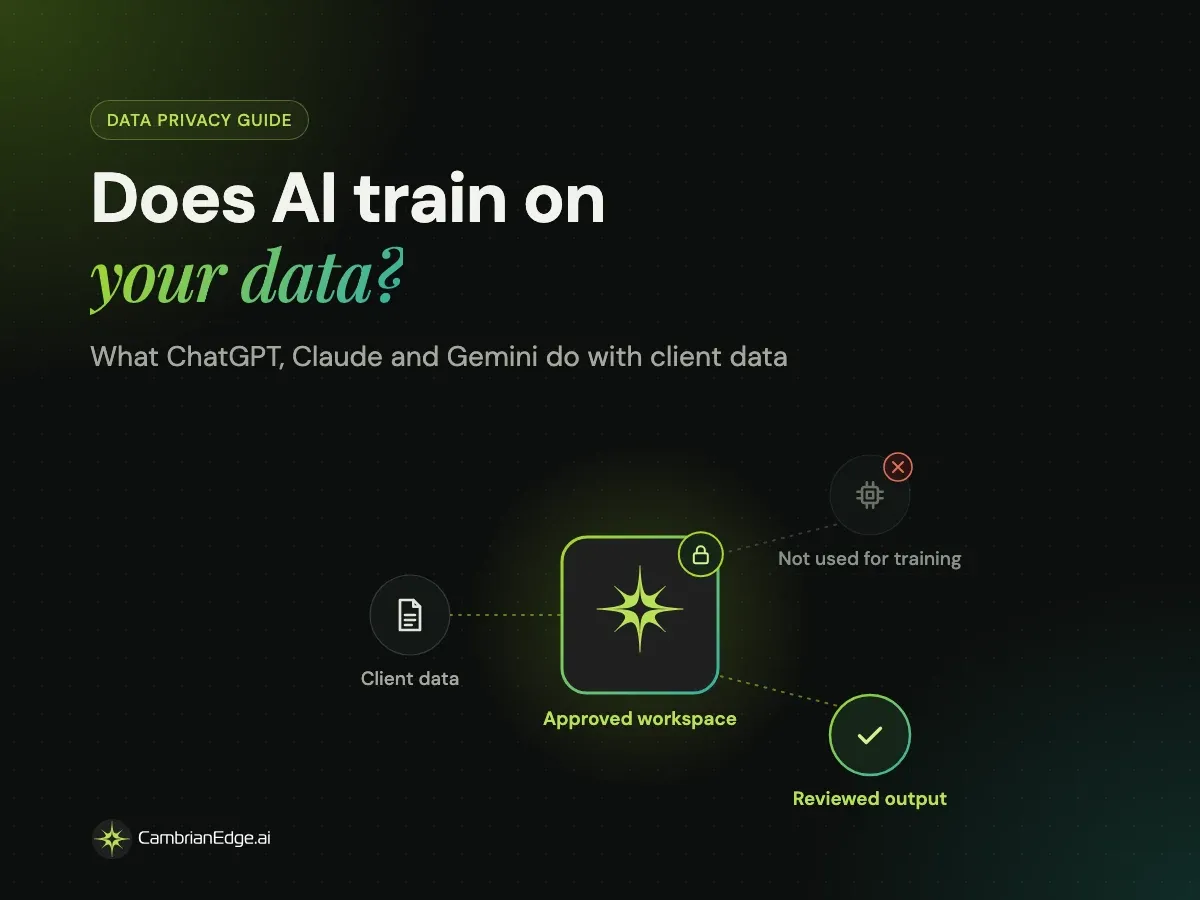
Does AI train on your data? What ChatGPT, Claude and Gemini do with client data

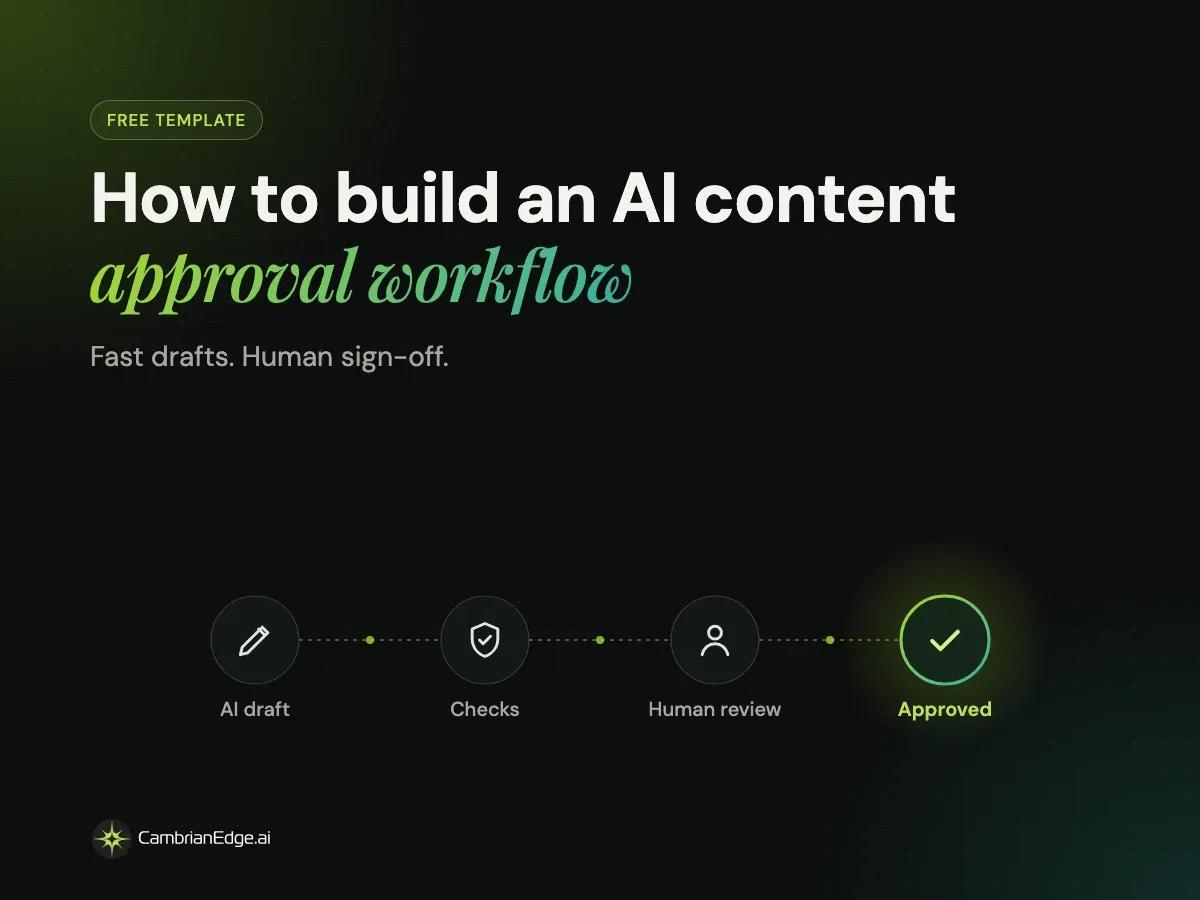
How to build an AI content approval workflow (free template)

Best AI tools for marketing agencies in 2026, picked by job