The real cost of marketing tool sprawl, and how to fix it without ripping out your stack
Every marketing stack tells a story about the brand. Most of them are telling it in six different voices.
Marketing tool sprawl is the build-up of overlapping tools and AI apps that each handle one task but do not share context. The subscription bill is the part you can see. The real cost shows up in the content: claims that drift, a brand voice that splits across channels, and rework that repeats in every tool. The fix is not fewer tools for its own sake. It is connected ones.
To see why, follow one sentence through a typical stack.
Follow one sentence through the stack
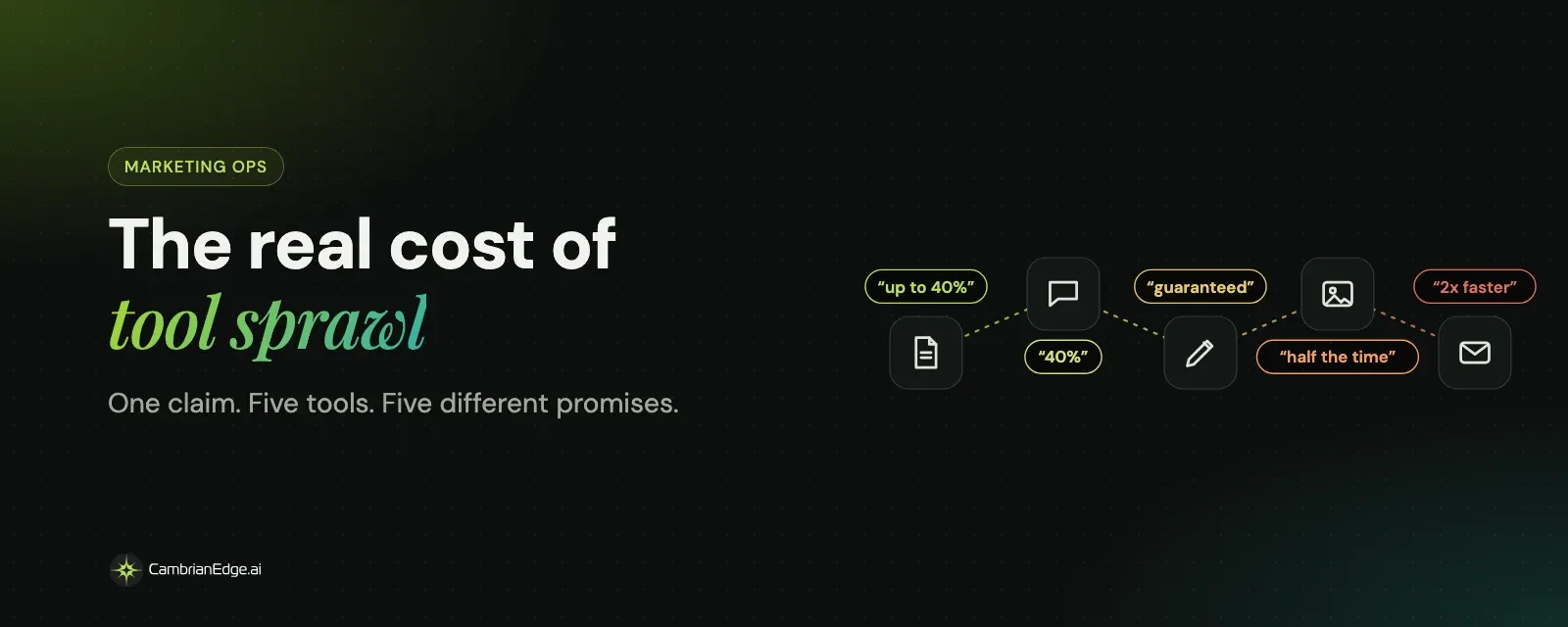
Take a single product claim and watch what happens to it. This is a thought experiment, but every marketer will recognize the path.
Stop | Where the sentence lives | What it now says |
|---|---|---|
1 | The campaign brief | "Cuts reporting time by up to 40% for teams that connect their data." |
2 | A chat assistant, first draft | "Cuts reporting time by 40%." |
3 | A writing tool, ad variants | "Reporting in 40% less time, guaranteed." |
4 | A design tool caption | "Half the reporting time." |
5 | The email platform | "Twice as fast." |
6 | The landing page | Still the original, because nobody updated it |
No one lied. Each person shortened the line a little to fit the format in front of them. Each AI tool rewrote it in its own default style, without the brief or the approved claim beside it.
By the time it reaches customers, one brand is making five different promises. Two of them it cannot defend.
That is tool sprawl. Not a long list of logins. A long list of places where the truth gets rewritten.
What is marketing tool sprawl, and why did AI make it worse?
Marketing tool sprawl is what happens when a stack grows one problem at a time. A tool for research, another for writing, another for design, another for scheduling, another for reporting. Each one solved a real problem. None of them was designed to share context with the others.
AI accelerated it. Every model, assistant and agent adds another interface where context has to be recreated.
The evidence is consistent:
- Utilization is falling. The 2025 Gartner Marketing Technology Survey found martech utilization has dropped to 49%, and only 15% of organizations qualify as high performers.
- AI agents are disappointing. In an October 2025 Gartner survey of 413 martech leaders, 45% of those with AI agents in pilot or production said vendor-offered agents fail to meet expectations.
- Agents are multiplying. Gartner projects that by 2028 an average Fortune 500 enterprise will have more than 150,000 AI agents, up from fewer than 15 in 2025, and only 13% of organizations believe they have the right agent governance.
- Teams use AI alone. In our own AI at Work survey, 55% said their biggest challenge is solo AI use or no hand-off between AI and people, and 27% have no shared AI infrastructure at all.
More capability, less connection. That is the pattern.
The invoice nobody sends
If tool sprawl sent you a monthly invoice, the subscription line would be the smallest number on it.
Line item | What it looks like | How to measure it |
|---|---|---|
Overlapping subscriptions | Three AI writing tools and several personal chat plans doing the same job | Sum of seats on tools that share a job |
Re-briefing | The same brief explained again in every tool | Hours per week spent restating context |
Moving work by hand | Copy and paste between draft, design, scheduling and email | Number of manual transfers per asset |
Rework | Editors fixing the same claim or tone in every channel | Revision rounds per asset |
Claims risk | Promises that drifted away from what is approved | Assets with claims not on the approved list |
Lost assets | Approved work nobody can find, so it gets made again | Assets recreated instead of reused |
Shadow AI | Client or company data in tools nobody approved | Tools in use that are not on the approved list |
What sprawl does to your content
The deepest cost of sprawl is not operational. It is what your audience reads.
- Claims drift. Facts and numbers change a little with every copy and paste, until the version that ships is not the one anyone approved.
- Brand voice splits. Every AI tool has its own default tone. Without one set of brand rules applied everywhere, a brand sounds like a committee.
- Quality depends on who touched it last. The same campaign reads differently by channel because each channel was written in a different tool.
- Content slows down. Context is rebuilt at every handoff, so the time AI saved in drafting is lost between tools.
- Good work disappears. Approved copy, research and images are scattered, so teams recreate what already exists.
Customers never see your stack. They see the inconsistency it produces.
How to calculate your sprawl tax
You can estimate the cost of sprawl in an afternoon. Use your own numbers in this formula:
- Overlap cost: monthly cost of every tool that duplicates another tool's job.
- Context cost: people affected × hours per week spent moving or re-explaining information × hourly cost × 4.3 weeks.
- Rework cost: hours per month spent fixing inconsistent claims or tone × hourly cost.
Your monthly sprawl tax is the sum of the three.
Here is an example with made-up numbers, to show how the math works. A 12-person team where each person spends 3 hours a week moving context, at a loaded cost of $60 an hour, loses about $9,300 a month in context cost alone. Add $1,200 in overlapping subscriptions and 20 hours of rework, and the tax passes $11,500 a month. Your numbers will differ. The shape usually does not: the subscription line is the smallest.
Why cutting tools is not enough
Cancelling subscriptions feels like progress. On its own, it rarely fixes sprawl.
If the approved tools are slower or weaker than what people were using, they find workarounds. Gartner makes the same point about AI agents: blocking them "is not a long-term solution," because people who cannot work in sanctioned tools go around the controls and start using shadow AI.
Consolidating without connecting just moves the copy and paste into fewer places. The goal is not the shortest tool list. It is one source of truth that every tool and every person draws from.
A five-step tool sprawl audit
- Inventory everything. List every tool and AI app in use, including personal subscriptions, with an owner, a cost and the data it touches.
- Map tools to jobs. Group them by the work they do: research, writing, design, video, publishing, reporting, automation.
- Decide keep, connect or retire. Keep tools that do a job no other tool can. Connect specialists that earn their place. Retire duplicates and anything nobody owns.
- Build a shared context layer. Put brand rules, approved claims, product facts and source documents in one place every tool and teammate draws from.
- Set a rule for new tools. Name the problem, check whether an approved tool already solves it, pilot with an owner and a review date, then decide.
For the workflow side of this change, read what an AI-fluent workflow looks like from brief to delivery, and for why matching the AI to the job matters, see the AI tax most agencies pay every quarter.
Connect, don't rip out
The enemy was never technology. It is disconnected work.
That is the idea CambrianEdge.ai is built on. It does not ask you to throw away the tools that work. It gives the work a shared environment:
- One source of claims and voice. Brand DNA holds each brand's voice, tone and guidelines, and the Knowledge Hub holds the approved documents and facts the AI drafts from. Claims are checked against your sources before review.
- One workspace for the work. Research, writing, images, video, social publishing and automations happen in the same place, so the brief travels with the asset.
- Model choice without more subscriptions. Teams use OpenAI, Claude, Gemini, Meta and Grok models per task, or leave it on Auto, instead of paying for a separate AI app for each.
- Your existing stack, connected. 43+ integrations, including Google Workspace, Microsoft 365, Slack, Salesforce and HubSpot, keep the specialist tools that earn their place.
- Sign-off built in. People review and approve before anything ships.
If you are deciding which specialist tools to keep, start with our guide to the best AI tools for marketing agencies, picked by job.
The sentence, one more time
Run the claim through a connected setup. It starts in the brief, lives once in the approved claims, and every draft, ad, caption, email and page is written from that same source.
"Cuts reporting time by up to 40% for teams that connect their data."
Six channels. One sentence. One brand telling one story.
To see what a connected stack looks like for your team, compare plans or book a demo.
Frequently asked questions


Harjiv Singh
As the Founder & CEO of CambrianEdge.ai, he is shaping the future of marketing through human-AI collaboration. With over 20 years of experience, he is dedicated to advancing AI-driven, human-centered marketing.

Share with your community!
Related Blogs
View All
Does AI train on your data? What ChatGPT, Claude and Gemini do with client data

How to build an AI content approval workflow (free template)

Best AI tools for marketing agencies in 2026, picked by job