What is a marketing operating system? Hint: it isn't the software you buy
In the 1890s, American factories started replacing their steam engines with electric motors. Then, for the better part of two decades, almost nothing happened to productivity.
The motors worked. The factories didn't change. That story is the best answer I know to a question I get asked often: what is a marketing operating system?
Here's the plain version. A marketing operating system is the way your team's work runs, from the signal that starts it to the result you measure. It covers where context lives, how people and AI pass work between them, who decides and how often, and how results feed the next plan. Software supports it. It isn't the software.
What the factories got wrong
The economist Paul David told this story in a 1990 paper, "The Dynamo and the Computer." Around 1900, electric motors drove less than 5% of the machinery in American factories. Even by the early 1920s, it was only a little over half.
Part of the delay was cost. Nobody throws out a working plant. But the bigger reason was imagination. Most factories took out one big steam engine and put in one big electric motor, still turning the same long shafts and belts across the same crowded floor. New power, old layout.
The gains came later, when factories put a small motor on each machine and redesigned the floor around how the work actually flowed. That's when productivity moved.
I've used this comparison before, and I'll keep using it, because I see the same pattern in marketing every week. Teams buy powerful AI and plug it into the old shafts and belts. The brief still travels by email. Context still lives in someone's head. Approvals still happen in a thread nobody can find. The motor is new. The floor isn't.
What AI says, and where it slips
Before writing this, we looked at what people hear when they ask AI about it. Most of the answers are good.
Ask "What is a marketing operating system?" and most answers get the idea. Every one of the 96 answers we checked talked about process or workflow, and most described a way of working rather than a product. One put it neatly: "an operating model, not necessarily a single software product."
Then ask for a marketing operating system "for agencies and startups," and the answers turn into a shopping list.

HubSpot came up in 62% of those answers, Notion in 48%, Zapier in 35%, Canva in 32% and ClickUp in 31%. People and roles, which came up in 72% of the definition answers, dropped to 36%. A decision rhythm, such as a weekly or quarterly cadence, came up in 46%.
How we checked: CambrianEdge.ai analyzed 192 answers from ChatGPT, Perplexity and Google AI Overviews to "What is a marketing operating system?" and "Marketing operating system for agencies and startups," 96 for each, recorded from October 7 to November 7, 2026. We counted by keyword match, so treat the numbers as direction.
They're all good tools. But that slip, from a way of working to a list of software, is the factory mistake in miniature. The moment the question gets practical, we reach for the motor and forget the floor.
The five parts of a marketing operating system
When I look at teams that run well, I see the same five parts, whatever tools they use.

- Signals. What starts work. A launch date, a client request, a competitor's move, a drop in a metric. A good system notices these quickly and routes them to an owner.
- Shared context. Positioning, brand voice, approved claims, audience insight and past work, kept in one place and attached to the work, so nobody re-explains the brand on every brief.
- Flow. Who does what, in what order, and which steps AI takes. Research and first drafts move fast. People shape, judge and approve.
- Decisions and rhythm. Who says yes, and when. A weekly cadence for what ships, a monthly one for what changes, and clear approvers for anything that leaves the building.
- The loop. Results come back to the people who made the call, and the next plan starts from what worked, not from a blank page.
Notice that only one of the five is about tools, and even that one is mostly about where things live. That's the point. AI makes every part faster. It doesn't make any of them exist.
Is it the same as AI orchestration?
Close, but not quite. The operating system is the whole way of working. AI orchestration is what makes it run once AI is in the mix: connecting people, models, context and approvals so work moves as one system.
If the operating system is the factory floor, orchestration is the wiring that gets power to every machine.
How it differs for agencies and startups
The five parts are the same. The pressure points aren't.

Agencies run one system for many clients. Each client needs its own context, voice and approvers. The workflow, review standards and reporting should stay shared, or every account becomes its own little agency. The test I'd use: can you set up a new client in days, without changing how the team works? We've written about what that does to agency capacity and to keeping client voices distinct.
Startups need less, and need it earlier. One place for positioning and approved claims. One weekly meeting where the team decides what ships. One simple view of what worked. A five-person team can run that in an afternoon a week. A 50-person team that never set it up will spend a quarter untangling it.
What they share is the risk of the old floor. An agency with great AI and no shared context gets fast drafts in the wrong voice. A startup with great AI and no decision rhythm ships a lot and learns very little.
CambrianEdge.ai's operating system audit
You don't need a consultant for this. You need five honest sentences.
Answer each question in one sentence. If you can't, or if your team gives different answers, that's where to start.
Part | The question | A good answer sounds like |
|---|---|---|
Signals | What starts work here, and who owns each signal? | "Client requests go to the account lead; metric drops go to ops." |
Context | Where does a new hire find our positioning and approved claims? | "In one workspace, attached to every brief." |
Flow | Which steps does AI take, and where does a person take over? | "AI researches and drafts; the editor shapes; the lead approves." |
Decisions | Who approves what leaves the team, and on what rhythm? | "The content lead, every Tuesday; legal for any claim." |
Loop | How do results reach the people who made the call? | "A monthly review that changes next month's plan." |
Run it with your leadership team and then with the people doing the work. The gap between the two sets of answers is usually the most useful thing you'll learn.
Where AI fits, and where we fit
I'll be direct about our view. AI belongs inside all five parts, but it shouldn't own any of them. AI accelerates. Humans direct.
That's how we built CambrianEdge.ai. Brand context and approved facts live with the work. Each client or brand can have its own workspace. Teams choose the right model for each task. Automations run on a schedule or when something changes in a connected tool, and they can wait for a person's approval before anything goes out. And it connects to the 43+ tools teams already rely on.
But I'd rather you ran the audit first. In CambrianEdge.ai's AI at Work survey of 136 professionals, 49% said their organization was still starting or experimenting with AI. The other 51% had begun integrating it or rebuilding work around it. Software didn't separate those two groups. The floor plan did.
Redesign the floor
The factories that won didn't buy better motors than their neighbors. They redesigned the floor so the power reached every machine.
That's the work in front of every marketing team now. The motors have arrived, and they're extraordinary. The question is whether we keep running them through the old shafts and belts, or build a floor worthy of them.
To see how this looks for your team, compare plans or book a demo.
Frequently asked questions


Harjiv Singh
As the Founder & CEO of CambrianEdge.ai, he is shaping the future of marketing through human-AI collaboration. With over 20 years of experience, he is dedicated to advancing AI-driven, human-centered marketing.

Share with your community!
Related Blogs
View All
How agencies can take on more accounts with AI, and give their teams room to do their best work

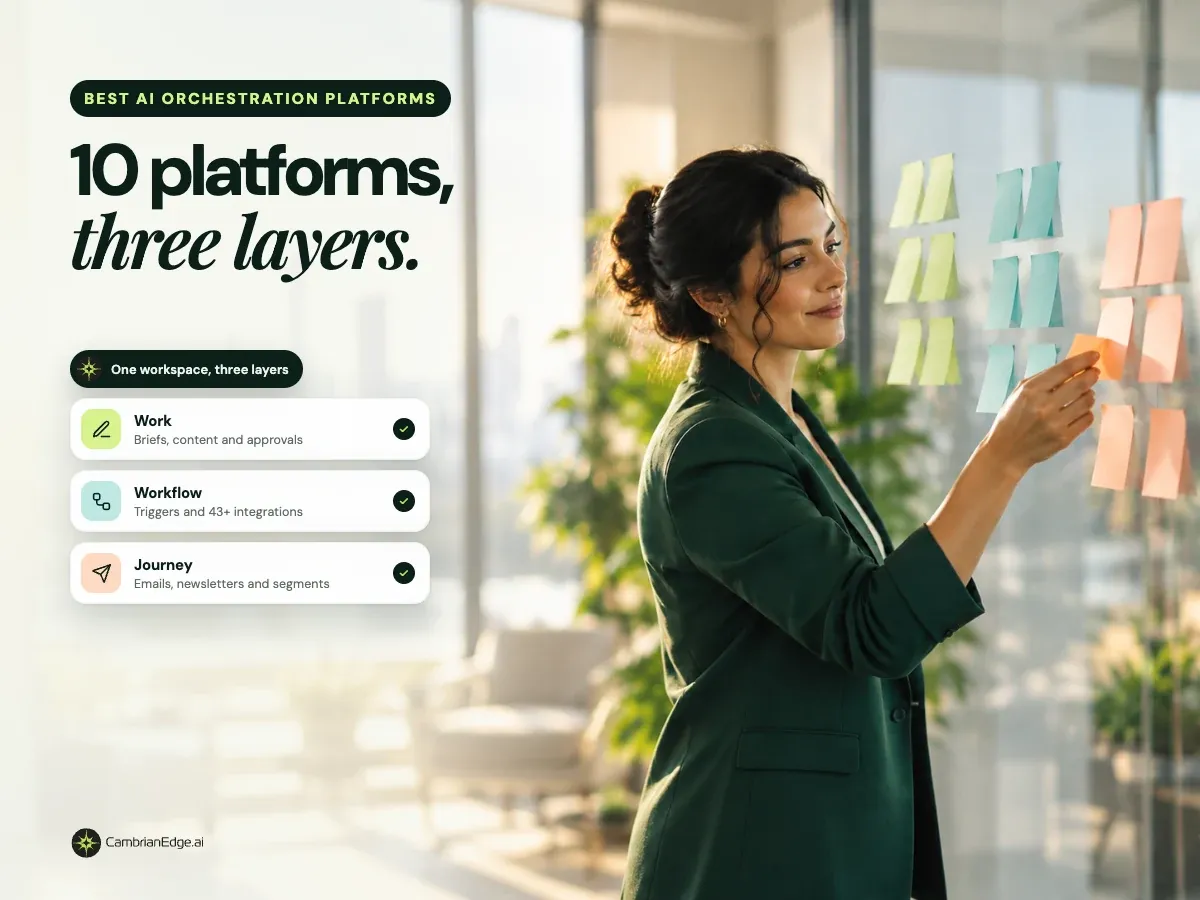
The best AI orchestration platforms for marketing teams, and the three layers they run
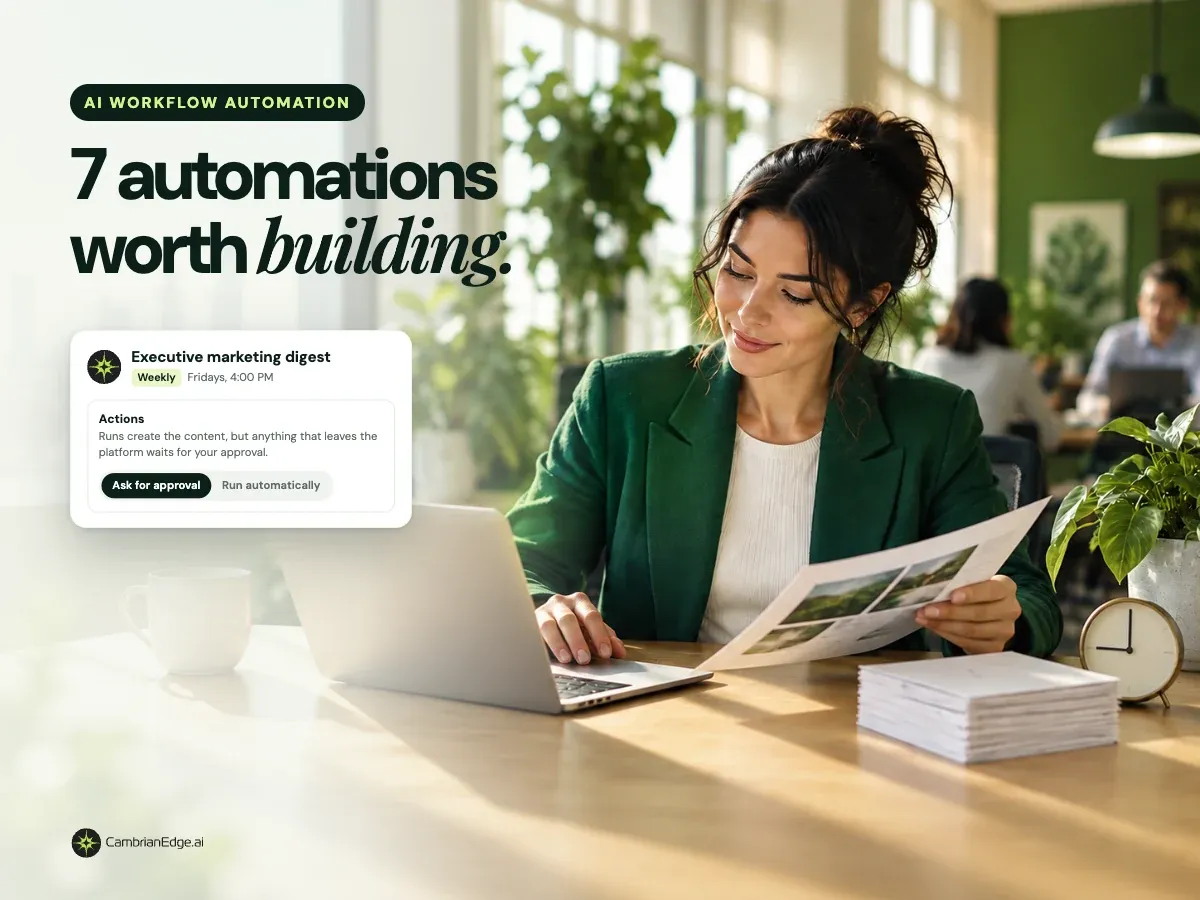
AI workflow automation for marketing: 7 automations worth building