How agencies can take on more accounts with AI, and give their teams room to do their best work
Hours saved are not capacity. They are raw material.
Agencies can take on more accounts with AI by doing two things: automating repeatable work, and deciding in advance where the saved hours go. Most agencies have done the first. The second is where growth comes from. Track the hours saved, reduce the hours lost to rework and re-briefing, and assign what remains to new accounts, deeper client work or the team's own development.
Here is that argument in five visuals.
Chart 1: what agencies are being told to do

We wanted to see what agency leaders hear when they ask AI this question. In CambrianEdge.ai's analysis of 90 answers from ChatGPT, Perplexity and Google AI Overviews, recorded from October 7 to November 5, 2026, 98% recommended automating client reporting and 98% recommended automating content and drafting. Only 7% mentioned pricing or retainers. Only 3% mentioned utilization. We counted these by keyword match, so read them as direction rather than exact measures.
The advice is sound, as far as it goes. It explains how to save the hours. It rarely explains what happens next.
Ask about margins instead of capacity, and the picture changes. In CambrianEdge.ai's analysis of 90 answers to a question about agency margins, 93% mentioned pricing or retainers and 24% mentioned utilization. The same economics, split into two separate conversations.
The hours are real. AgencyAnalytics' 2026 benchmarks report, based on 494 responses, found 79% of agencies save five or more hours a week with AI, and 35% save ten or more.
So the question is not whether AI saves time. It is where that time went.
Chart 2: where ten saved hours go

This chart is an illustrative model, not survey data. Use it to see the shape of the problem, then replace our numbers with yours.
Say an account manager saves ten hours in a week. Three go to checking and fixing drafts. Two go to re-explaining the client's context and moving work between tools. Two more go to unplanned requests. Three remain.
There are three leaks, and each has a cause:
- The review leak. Drafts arrive fast, but they arrive without the client's rules, so people repair them. We have written about how the approval queue became marketing's new bottleneck.
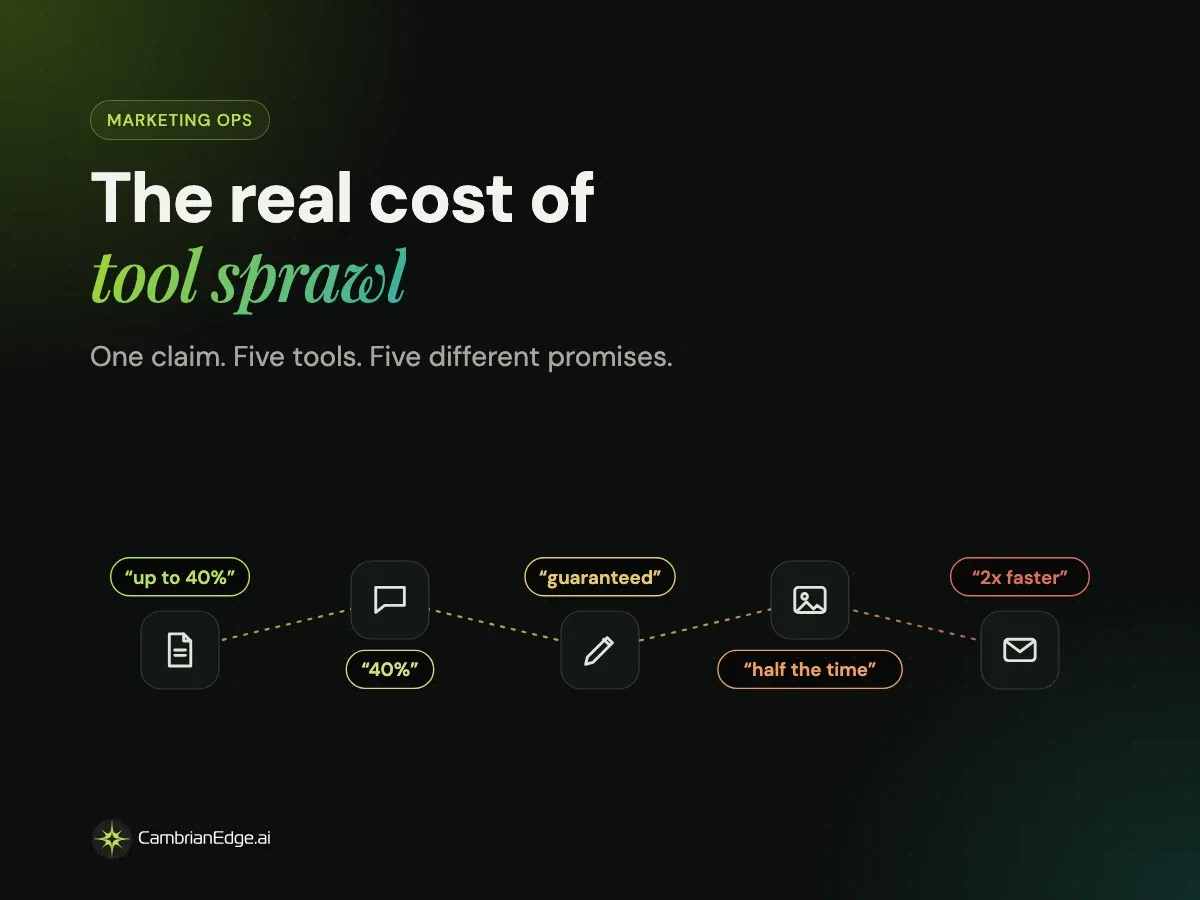
- The context leak. Each tool starts from zero, so people carry the brief by hand. That is the hidden cost of marketing tool sprawl.
- The drift leak. Freed time with no owner fills up with whatever is loudest that day.
None of this is a failure of the team. It is what happens when work speeds up and the system around it stays the same.
Chart 3: the capacity math

The formula fits on a sticky note:
Added accounts per person = hours redeployed each week ÷ hours each account needs each week
Take the model above and assume each account needs four hours a week. Three redeployed hours adds room for 0.75 accounts per person. For a team of five, that is 3.75 accounts.
Now shrink the leaks so six hours are redeployed instead of three. The same formula gives 1.5 accounts per person, or 7.5 accounts for the team. The hours saved never changed. The share that reached client work doubled.
That is why I would rather see an agency measure its ten hours than chase fifteen.
Not every redeployed hour should go to a new account, either. AgencyAnalytics found 68% of respondents already spend 60% or more of their time on billable work, so some of the gain belongs in strategy, client relationships and skills. Forrester's 2026 research with the 4As makes the same case, urging leaders to reinvest efficiency gains into talent, training and marketing operating systems. Its analyst warns of the risk of "mistaking efficiency for effectiveness."
Capacity is the room to choose. Some agencies will choose more clients. Others will choose better work for the clients they have. The strongest will do both.
CambrianEdge.ai's capacity ledger
To make the choice visible, we suggest a simple weekly record. We call it the capacity ledger. Copy this table into a spreadsheet and fill it in for each team.
Ledger line | What to record | Illustrative hours | Owner |
|---|---|---|---|
Hours saved | Time AI saved on reports, drafts and research | 10 | Team lead |
Lost to review | Time spent checking and fixing AI drafts | 3 | Content lead |
Lost to context | Time spent re-briefing and moving work between tools | 2 | Account lead |
Lost to drift | Time absorbed by unplanned requests | 2 | Team lead |
Hours available | Saved minus lost | 3 | Team lead |
Redeployed: new accounts | Hours assigned to new client work | 1 | Agency lead |
Redeployed: deeper work | Hours assigned to strategy for current clients | 1 | Account lead |
Redeployed: team growth | Hours assigned to training and skills | 1 | Team lead |
Review it every two weeks, and pick one leak to close at a time. After a quarter, you will know something few agencies know: how much capacity AI actually gave you, and where it went.
Chart 4: closing the leaks

Each leak has a design fix, and each fix belongs before the work starts. In this model, the same ten saved hours now leave six to redeploy.
- For the review leak, approve the inputs once. When AI drafts from approved voice rules and facts, reviewers check what is new instead of repairing the basics. Our AI content approval workflow shows how to set this up.
- For the context leak, give each client one home. Keep the brand rules, documents and work together, so the brief travels with the asset.
- For the drift leak, put recurring work on a schedule. Reports and briefs should arrive on time with a named approver. Our guide to AI workflow automation covers seven automations to start with.
People stay at the center of this. AI provides the speed. People provide the judgment, the client relationship and the final yes.
Chart 5: what good looks like

Gutenberg, a global agency and CambrianEdge.ai customer with more than 100 people in 7 countries, reached 100% team AI adoption, 5x faster execution and 90% first-draft approval. You can read the details in the Gutenberg customer story.
These are execution numbers, and they map directly onto the ledger. First-draft approval is the review leak, measured. When nine in ten first drafts are approved, fewer of the saved hours go to repair, and more are available to spend on purpose.
How CambrianEdge.ai supports the ledger
CambrianEdge.ai is a human-led AI orchestration platform for marketing teams, and each part of it maps to a leak.
- Review: Brand DNA holds each client's voice, and the Knowledge Hub holds approved documents and facts, so drafts start closer to right.
- Context: each client can have a separate workspace, with 43+ integrations connecting the specialist tools you keep.
- Drift: automations run on a schedule or from integration events, with an approval step before anything leaves the team.
- Measurement: Content Impact shows hours saved, work produced and milestones by person, which gives you the first line of the ledger.
See how this works on our agencies page.
Start this month
- Pick one team and run the ledger for four weeks.
- Automate one recurring job, such as the client report.
- Close one leak, usually review, by approving the inputs up front.
- Assign the freed hours by name: new accounts, deeper work or team growth.
- Talk about value with clients. Forrester reports that 61% of agencies still classify AI as a cost of business. Better output and faster turnaround are worth pricing.
Most agencies have found the hours. The ones that pull ahead will be the ones that decide what those hours are for.
To map this to your agency, compare plans or book a demo.
Frequently asked questions


Harjiv Singh
As the Founder & CEO of CambrianEdge.ai, he is shaping the future of marketing through human-AI collaboration. With over 20 years of experience, he is dedicated to advancing AI-driven, human-centered marketing.

Share with your community!
Related Blogs
View All
The best AI orchestration platforms for marketing teams, and the three layers they run


AI workflow automation for marketing: 7 automations worth building

The real cost of marketing tool sprawl, and how to fix it without ripping out your stack